Block Customer logoBlock Customer
SolutionMerchant guide

shopify fraud prevention before checkout

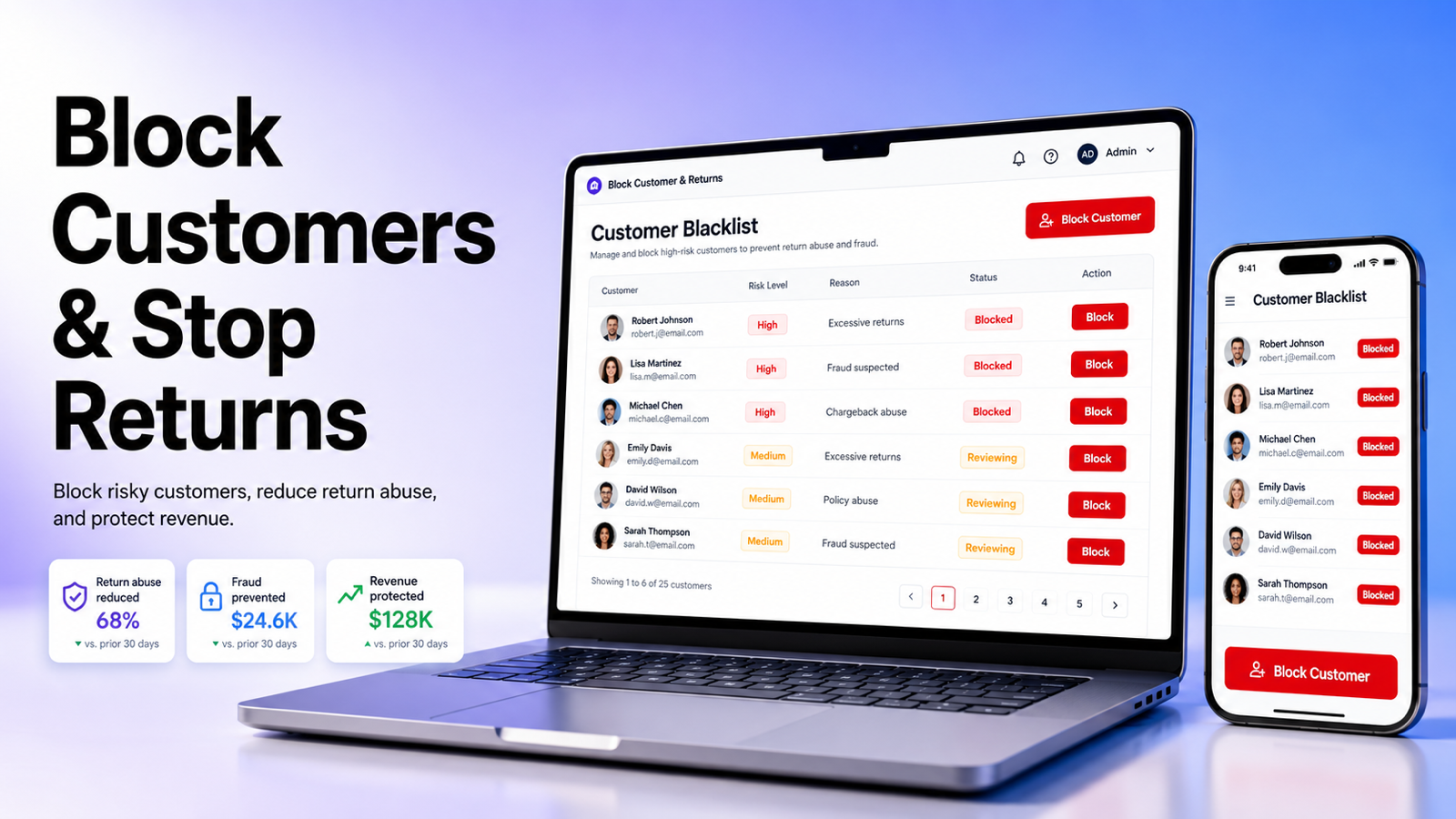
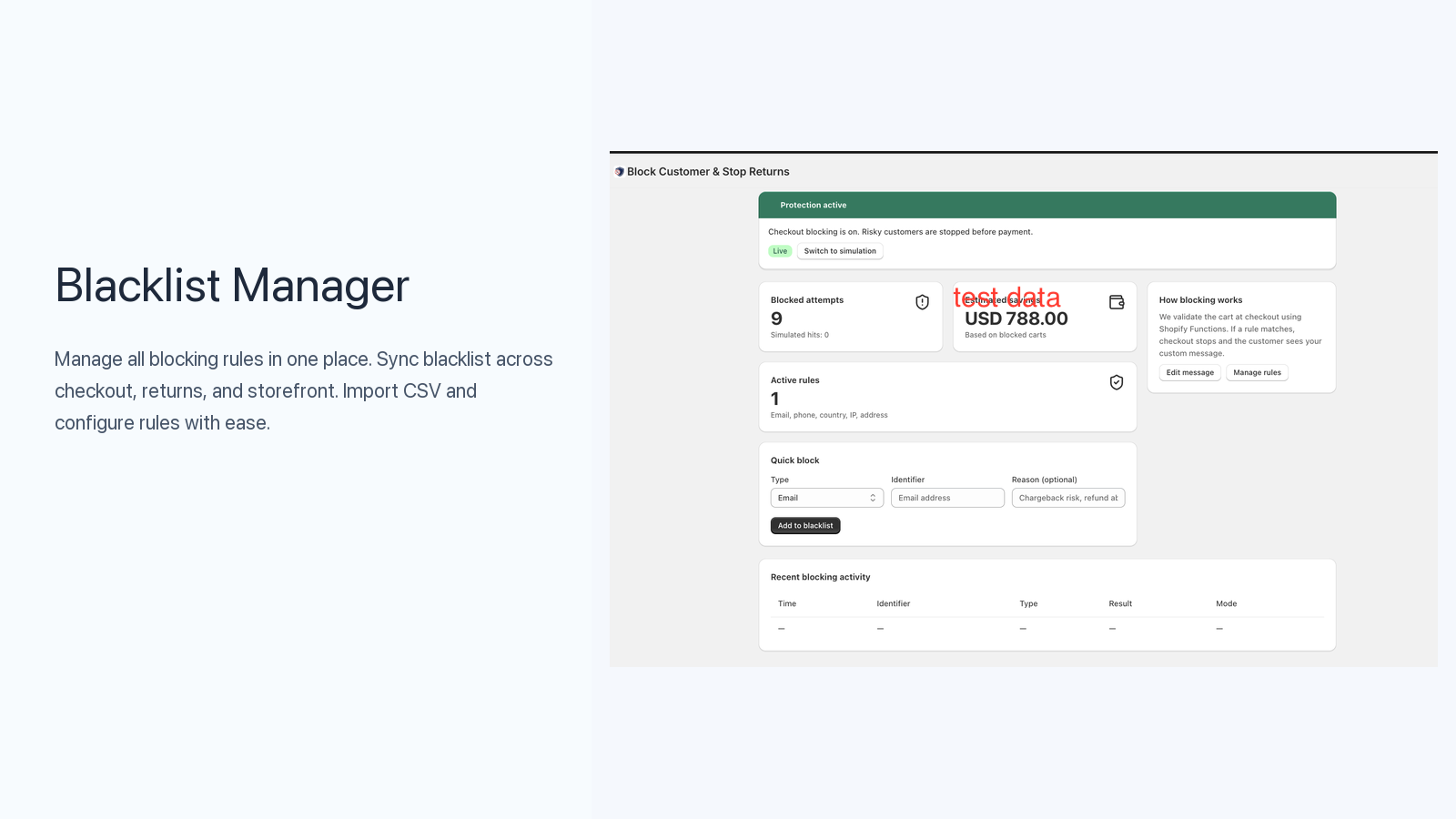
Shopify fraud prevention should do more than warn your team after a suspicious order appears. When a repeat buyer uses the same email, phone, address, country, or IP pattern, Block Customer & Stop Returns lets you stop that checkout before payment.

shopify fraud prevention dashboard example for Shopify checkout risk

Merchant need

Why merchants need Shopify fraud prevention

Most merchants look for fraud prevention after seeing chargebacks, fake orders, refund abuse, failed delivery costs, or the same customer coming back with a new account. The real need is control at the point where risk becomes cost.

01

Stop known bad buyers before a paid order is created.

02

Turn repeated fraud clues into clear rules your team can audit.

03

Keep native fraud review for unknown risk while blocking known risk earlier.

Practical checklist

Practical shopify fraud prevention checklist

Use shopify fraud prevention as a rule layer, not a guess. A clean shopify fraud prevention setup starts with a confirmed buyer signal, a short reason, and a test checkout before the rule goes live.

CHECK 1

Start from evidence

If your team asks how to shopify prevent fraud, begin with the exact detail that repeated across risky orders. Fraud detection shopify tools can flag new risk, while shopify fraud prevention rules stop known repeat signals.
CHECK 2

Keep the block narrow

Strong shopify fraud prevention uses email, phone, address, country, or IP only when the signal is trustworthy. That keeps the rule useful for known abuse and safer for good shoppers.

CHECK 3

Review after launch

Treat shopify fraud protection as a stack. Keep native checks for unknown risk, then use shopify fraud prevention rules when the same pattern returns and your team can explain why.

shopify fraud prevention rule flow example for buyer detail review
shopify fraud prevention customer and location control example
Solution design

What Block Customer adds to fraud prevention

Block Customer & Stop Returns focuses on known risk. It is not a payment processor and it does not promise to identify every fraud attempt. It helps when your team already has buyer signals that should not be allowed through checkout again.

RULE 01

Buyer detail rules

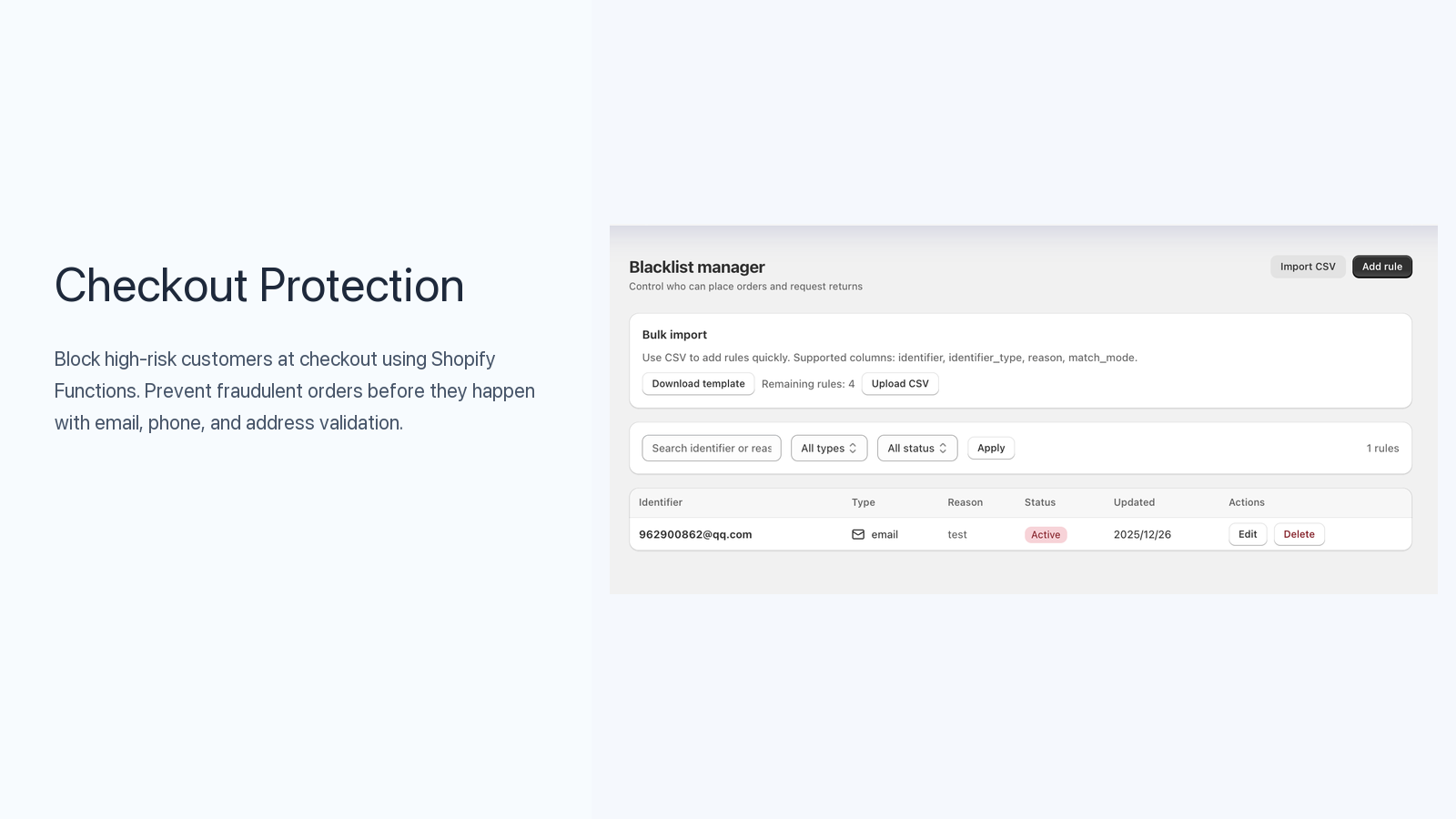
Block by email, phone, name, address, country, or IP when the pattern is specific enough to trust.

RULE 02

Checkout stage control

Stop the risky buyer before the store accepts payment instead of cleaning up the order afterward.

RULE 03

Allow and block actions

Use allow rules for known safe cases and block rules for confirmed abuse patterns.

Operating steps

Build a fraud rule without overblocking

Use a simple process. Start narrow, test, then review matches after launch.

1

List the risk pattern

Start with the buyer detail you can verify, such as email, phone, name, address, country, or IP. Keep a short note for your team so every rule has a clear reason.

2

Create a precise rule

Add the rule in Block Customer & Stop Returns and choose whether it should block or allow. A narrow rule is easier to review than a broad rule that stops good buyers.

3

Test the checkout path

Run a safe test order or preview the storefront flow. The goal is simple: a known risky buyer should not reach a paid order.

4

Review the log after launch

Check matched rules, order context, and customer signals. Remove old rules when the risk has passed or when a legitimate buyer needs access again.

Decision matrix

Native fraud review vs checkout blocking

These controls work best together. One helps you judge risk. The other stops known risk from ordering again.

Decision point

What it catches

Native tools can flag risk or help with order review after the buyer reaches the store flow.

Block Customer & Stop Returns turns known risk signals into a checkout blocking rule.

Best use case

Good for general fraud review, payment checks, and internal merchant judgment.

Good for repeat return abuse, known bad customers, fake order attempts, and policy based blocks.

Control level

Rules may depend on plan, payment method, eligibility, or manual review steps.

Rules can match buyer details such as email, phone, name, address, country, and IP.

Proof and limits

The honest limit

No app can make fraud disappear. Strong Shopify fraud prevention is a stack: payment checks, clear return rules, order review, customer service notes, and checkout blocking for repeat patterns. This page focuses on the blocking layer.

Use exact buyer signals before broad location rules.
Review blocked attempts so the list stays clean.
Keep records for support and chargeback discussions.
FAQ

FAQ

Short answers for merchants comparing blocking, fraud prevention, and Shopify checkout rules.

Is Shopify fraud prevention the same as blocking a customer?

No. Fraud prevention can include review, payment checks, order cancellation, or blocking. Customer blocking is the part that stops a known risky buyer from placing another order.

Can I block a customer by email or phone?

Yes, the app supports rules for buyer details such as email and phone. You should use the most specific signal available.

Should I block whole countries for fraud prevention?

Only when you have a clear operational reason such as fraud concentration, shipping limits, or compliance needs. Do not use country rules for discriminatory targeting.

Does this replace Shopify native fraud tools?

No. Treat it as a checkout blocking layer for known risk. Keep native risk checks for unknown or new patterns.

Add a blocking layer to your fraud stack

Install Block Customer & Stop Returns and turn repeated fraud patterns into rules before they become another order.

Open on Shopify App Store